Six well-known friends, writers and contemporaries of “From Here To Eternity” author James Jones, whose work captured the essence of the pre-World War II military, combat during the war, veterans and the post-war period in this country, spoke about their relationship with him at the 1999 James Jones Literary Society Symposium held at Southampton College and hosted by the MFA program at Long Island University.
Jones died in 1977, but these famous guests shared their stories (and a few disagreements), his influence on their writing, and even how he met his wife, Gloria, and their three-week whirlwind courtship in 1957 that culminated in a Caribbean wedding six years after “From Here to Eternity” was published and became a bestseller.
The transcript of the symposium had been misplaced for years.
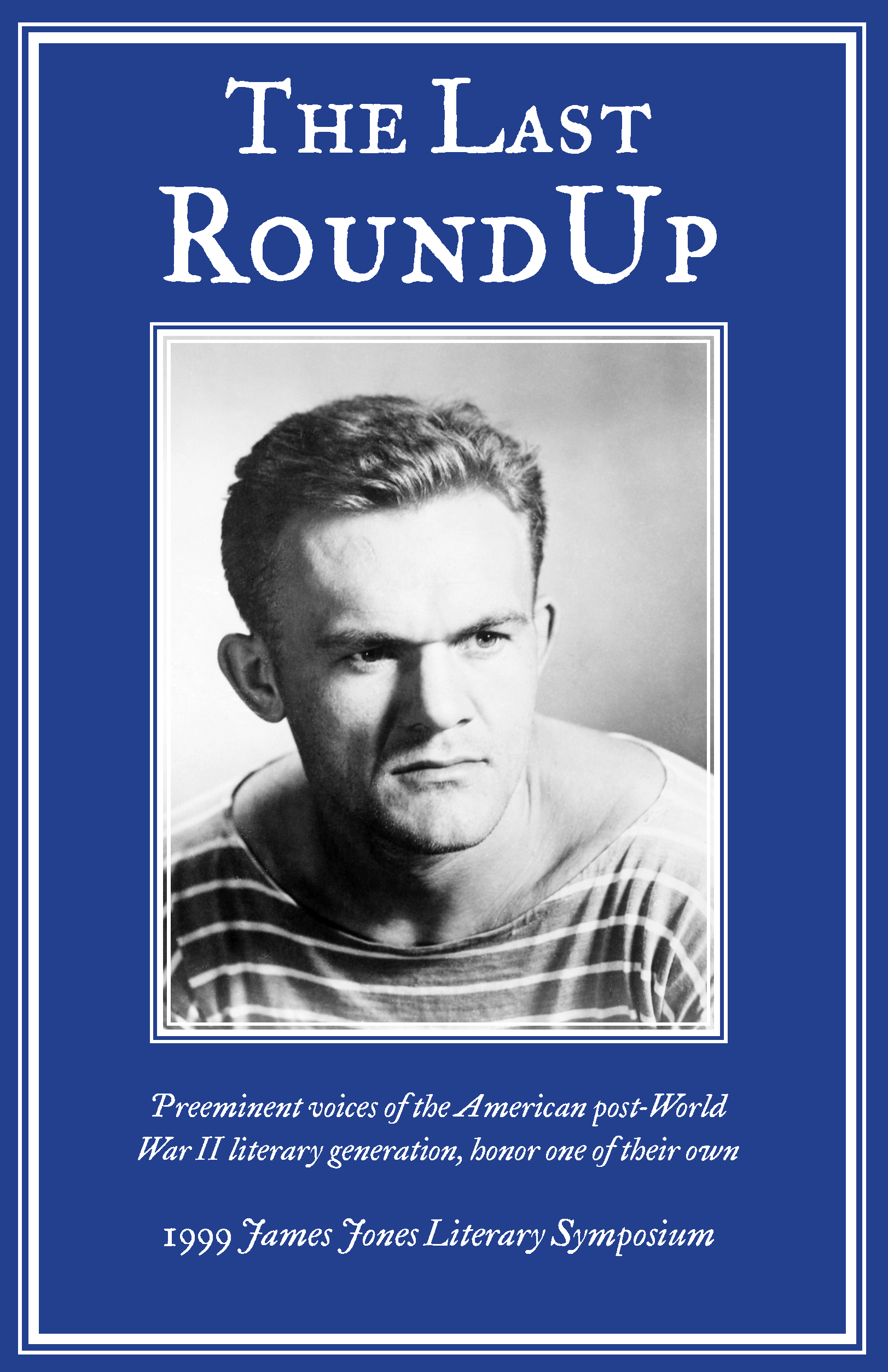
When it was finally located, carefully transcribed and edited, it was published as “The Last Round Up” by the James Jones Literary Society. The transcript features prominent World War II-generation writers who were invited to the event by Jones’ daughter and author in her own right, Kaylie:
Budd Schulberg (“On the Waterfront”)
Joseph Heller (“Catch-22”)
Betty Comden (“Singin’ in the Rain”)
Norman Mailer (“The Naked and the Dead”)
William Styron (“Sophie's Choice”)
Peter Matthiessen (“The Snow Leopard”)
Of those she invited, only Kurt Vonnegut (“Slaughterhouse-Five”) couldn’t make it because his son was getting married. The JJLS even hired a small aircraft to fly Norman Mailer and William Styron from Cape Cod and Martha’s Vineyard to Long Island.
Like Jones, this prominent group of writers became famous for their work fairly early in their lives and provided great insight into the decades surrounding WWII and the impact on American life. Kaylie, who was teaching at Southampton at the time, had organized the symposium for the Society about her father, who was best known for his awarding-winning, highly acclaimed novel that included the pre-war Army, the attack on Pearl Harbor when Jones was stationed at Schofield Barracks, and going to war. The novel was later made into an award-winning movie, starring Burt Lancaster, Deborah Kerr and Montgomery Clift.
The transcript preserves a historic moment in American letters, bringing together the voices of writers who lived through, and wrote about, the defining conflict of the 20th century, all in honor of one of their most celebrated peers.
Having heard these writers at the symposium and having read the book twice now, there is no doubt that the event captured the wit, wisdom and personal reminiscences of the group.
Kaylie introduced the book with a section from her memoir, “Lies My Mother Never Told Me,” where she recalls the time of the symposium. Following in her father’s footsteps, Kaylie is a novelist and a professor of practice at Stony Brook University on Long Island. One of her novels, “A Soldier’s Daughter Never Cries,” was also made into a movie starring Kris Kristofferson and Barbara Hershey. The film was featured in Champaign as part of Roger Ebert’s Film Festival in 2003.
Her latest book, “Veritas,” is a work of speculative fiction and will be published by Akashic Books in June 2027.
After her opening excerpt, “The Last Round Up” then features an article by longtime Jones scholar and JJLS board member, J. Michael Lennon, about Jones’ trilogy: “From Here to Eternity,” “The Thin Red Line” and “Whistle,” before going on to introduce each guest.
About the symposium Lennon writes, “They recalled Jones’ books, his irrepressible energy, courage and other accolades, (including the 1952 National Book Award) and his generosity to other writers.”
When Kaylie concluded the 1999 symposium with some closing comments, she mentioned that Vietnam veteran and author Larry Heinemann had driven to Long Island from Chicago to attend the symposium. Heinemann was to Vietnam what the writers at the symposium were to World War II. He also had received the National Book Award in 1986 for “Paco’s Story.”
The narrator of that book, who is the ghost of a dead soldier from Paco’s platoon, tells the entire story directly to a listener he repeatedly addresses by name as James. Heinemann has said that was for James Jones, who had influenced him and his work. He had sent a copy to Gloria Jones, who kept it on her coffee table, where it remained through the years.
Of course, Kaylie was also greatly influenced by her father. The New York Times had once written that while the second generation of actors often “equaled the accomplishments of their parents,” that hadn’t been the case for second generation novelists. But Kaylie was one of the exceptions.
She was able to convene this rare gathering of some of the greatest literary voices of the mid-20th century, who offered many examples of their friendship and respect for James Jones.
About Jones’ writing Styron said, “Jim was serious about fiction in a way that now seems a little old-fashioned and ingenuous. He saw it as a sacred mission, as icon, as Grail.”
Sadly, all of these voices are now silenced by the passage of time, and the book is as much a historical document as it is a celebration of James Jones.
“The Last Round Up” is now available at Tales Press (www.talespress.com) and on Amazon.