
Growing up in a small rural village in southeastern Illinois during the post-World War II period, I was surrounded by veterans who served and fought in Europe and the Pacific.
My older cousin, Bruce Elliott, landed on Omaha Beach at 0630 on June 6, 1944, with the 741st Tank Battalion in an M4A1 Sherman tank modified for “deep wading” in the Easy Red sector with the first wave of troops from the 1st Infantry Division.
These tanks were outfitted with tall exhaust and intake trunking extensions to prevent the engine from stalling in deep water. They were transported all the way to the shallows of Omaha Beach directly via landing craft.
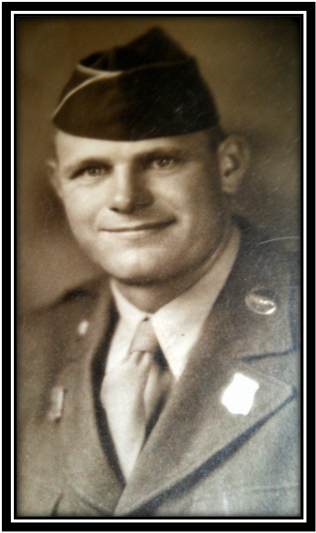
Bruce Elliott
The water in the English Channel was very rough from bad weather, and the Navy destroyers and cruisers were firing broadsides at the German installations.
Bruce’s tank was capable of launching from the landing craft in about 8 feet of water. He was a crewman and gunner in the 2nd Platoon of A Company, and fought on through Europe, including the Battle of the Bulge. He made the 1,750-mile battle-scarred push to Plzen, Czechoslovakia, reaching there on May 6, 1945, two days before the end of the war in Europe.
Other companies in the battalion didn’t make it to the beach. B and C companies were equipped with “Duplex Drive” amphibious Sherman tanks. Also referred to as “Donald Ducks,” they were fitted with a collapsible canvas flotation screen and twin propellers, allowing them to “swim” to shore from several thousand yards out in the Easy Red sector with the first wave of troops from the 1st Infantry Division.
These “floating tanks” were launched 6,000 yards— 3.5 miles — from shore. None of the C Company tanks got there.
Bruce’s tank was one of nine from A Company that successfully landed shortly after H-Hour. According to the history of the 741st Tank Battalion — assigned to support the 1st Infantry Division in the “assault of Omaha Beach”— only 21 made it. There are only estimates of how many men lost their lives and never made it ashore.
Bruce described his tank’s action on Omaha Beach in the 741st unit journal: “Lt. McDonough’s tank landed on D-Day at 0650 hours. Immediately after hitting the beach, opened fire upon targets to our left, fired both 75 mm and 30 cal. Moved very slowly down the beach firing the thirties in weeds and trees, ahead of advancing foot troops. Then withheld fire for a period of time to locate more certain targets. Then picked up what we thought was an emplacement and started firing 75 mm again as we slowly moved up the beach. As we crossed a break in the bank away from the beach, we were hit in the side of the tank and were put out of action.”
None of the tank’s crew were injured or disabled, and they fought alongside the infantry until the breakout from Normandy and didn’t get another tank until near Saint-Lo. By then, the battalion was attached to the 2nd Infantry Division and participated in the hedgerow fighting and the fierce Battle of Vire in early August between the 29th Infantry Division and the German Wehrmacht.
From there, the 741st headed toward Paris. The city was officially liberated on Aug. 25, and the 741st Tank Battalion and other units marched around the Arc de Triomphe and down the Champs Élysées in a huge parade on the 26th.
After two days outside of Paris, it was on through northern France and into Germany, where the battalion spent the autumn of 1944 “bogged down in a grueling stalemate against Germany’s West Wall.”
By Dec. 15, the weather had turned very cold and the rough terrain was covered with snow as they engaged in the fierce fight of the Battle of the Bulge. Bruce’s A Company “fought with immense heroism during the opening days of the battle.”
After the Battle of the Bulge, the 741st Tank Battalion refitted in Belgium, then spearheaded the U.S. 2nd Infantry Division’s advance into Germany. They crossed the Rhine at Bad Breisig in March 1945, helping liberate the Flossenbürg concentration camp in April, and pushed all the way to Plzen, Czechoslovakia, near the end of the war on May 6.
Somewhere during the 1,750-mile journey from Omaha Beach to Plzen, Bruce had a tank hatch smash down on his head as the crew hurried back aboard from a respite outside when a German patrol came upon the tank, leaving him with a neck injury that bothered him for the rest of his life.
After the war, Bruce drove a truck for my father, and I rode with him whenever I could tag along. One time when I was about 8 years old, I asked him if he was in the war. He looked over at me with a strained look on his face, then grinned and said, “Oh, I reckon, you little dickens.”
He later told me he wouldn’t take a million dollars for what he had seen, but he wouldn’t take a million dollars to do it again, either.
As a kid, I didn’t realize what he’d been through or how it had affected him. Once when we were loading a calf at the farm of the father of a man who had served with my cousin from basic training on through the war, I saw Bruce dive under the truck after a loud crack of the thunder. I jumped back, scared.
“He was in the war, son,” the farmer said quietly.
Another time, I saw him dive from the unloading dock at the Indianapolis stockyards. The trucker in the next truck asked him if he was OK. Bruce just climbed back up and unloaded the cattle.
The last time I saw him, he was standing at the back of a community gathering in his small village with his neck wrapped and twitching his head from side to side. That wasn’t long before he spent the evening of June 6, 1982, burning papers at a pit in back of his house. The next morning, he put a shotgun in his mouth and pulled the trigger.
Everybody was shocked. By then, I was aware of the cost to those who fight our wars and die or live with the scars of battle for the rest of their lives. Besides the initial shock I had when I heard the news, I was shocked again when the local newspaper’s headline said, “Annapolis man takes own life,” and never mentioned Bruce’s service and sacrifice.
I based a character on him in my novel, “Wild Hands Toward the Sky,” about a boy losing his father in Guadalcanal at 2 years of age, and lamented in the prologue about the seeming lack of public awareness and significance of the June 6 anniversary that Bruce’s character chose to take his own life.