
Memorial Stadium stands for honor and sacrifice, not for sale to the highest bidder
Words matter more than we may realize; they matter when we tell the truth; they matter when we tell lies. But often today, when we read them on official publications or hear them spoken by those we trust, we believe them. At least some of us do; some of us don’t.
As an example, I just read on the University of Illinois Athletics’ official website that “Gies Memorial Stadium was built in 1923 as a memorial to Illinois men and women who gave their lives for their country during World War I.”
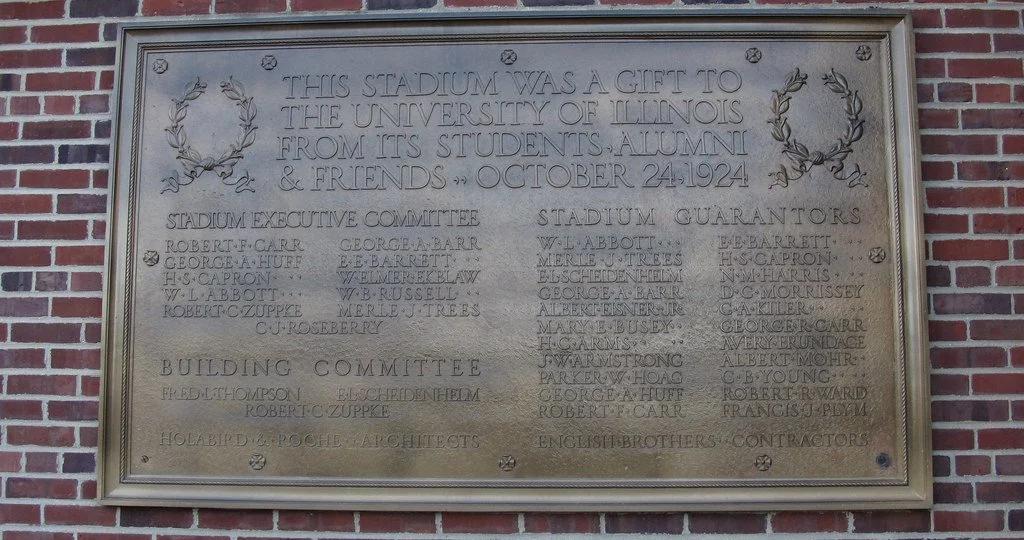
Plaque detailing the original gift of the stadium to the University of Illinois from its students, alumni and friends.
Which is essentially true, except that the name Gies was not added until adding the name was sold to Larry Gies Jr. for $100 million in September 2025 and is misleading. Not only was the statement not totally true, it’s been questioned whether it’s really legal.
While I’m not a lawyer or a judge, I don’t know if it’s legal and don’t care if it is or not. It is the lack of consideration for the honor to those students and alumni who sacrificed and gave their lives in World War I that matters. I do pay particular attention to those words and what they mean.
It is common knowledge that Memorial Stadium was built in 1923 as a memorial to 189 Illinois students and alumni who gave their lives for their country during World War I. Their names appear on the limestone columns that support the east and west sides of the stadium. Those 200 Doric columns at the University of Illinois’ Memorial Stadium with those names are “elegant and give reverence to those who gave their lives for our freedom.”
That honor shouldn’t be for sale. Can you imagine adding anybody’s name to the National World War I Memorial, the National World War II Monument, the Korean War Veterans Memorial, or Vietnam Veterans Memorial, all in Washington, D.C.? Adding anyone’s name to those memorials, or others around the country, shouldn’t be for sale — anywhere.
At Memorial Stadium in 2002, another 948 students, alumni, faculty and staff who have been killed in our wars and conflicts since 1918 have been engraved on four limestone tablets at the east and west colonnades but not directly with the names of the World War I service members on the original structural columns in whose honor Memorial Stadium was originally dedicated.
One of those 948 was Navy Cross recipient Marine 2nd Lieutenant David Skibbe, a 1969 University of Illinois graduate who is still missing in Vietnam after he was wounded on March 2, 1970, in the Quang Nam Province of South Vietnam and a rescue hoist cable snapped while he was being evacuated following a firefight. Even adding his name to the stadium as Skibbe Memorial Stadium would not be appropriate. He is only one of the many who gave their lives.
Memorial Stadium honors those students, faculty and alumni like the lieutenant for their sacrifices. Their sacrifices are sacred and should be remembered as it was meant to since the stadium was built. Before the dedication on Friday, October 17, 1924, classes were cancelled and offices closed to enable everybody to attend the dedication exercises. Former servicemen led a parade with more than 15,000 students, graduates and visitors to the ceremony. University of Illinois President David Kinley and Director of Athletics George Huff officiated with the president delivering the primary dedication address.
“Dedication of the stadium is our eternal rejection of the philosophy of brute strength,” Kinley said. “This stadium is a memorial to those of the university who died in the world war. We cannot hallow it by our words, but they have hallowed it by their deaths in defense of ideals and principles in which they believed. It is for us to keep it hallowed by living those principles. The uses to which this great structure (were) put must be uses which exemplify those principles.”
Following Kinley’s address, the names of the 189-war dead to whom memorial columns were dedicated were read. The ceremony concluded when 1916 Illinois graduate Lew Sarett delivered his “Ode to Illinois,” a poem of seven stanzas that traced the history of the state from early pioneer days to that very day of the dedication:
“Know that the broken hosts
Of martial-moving ghosts,
Who gave to a warring world their last full breath,
And won to immortality in death,
Hovering in stadium shaft and tower height,
In memorial court and buttressed peak,
Shall watch for you, and speak
To you of Great Moments in a Greater Fight.
O Men of Illinois, in war and peace and play,
So may we live that when the crucial fight is won,
And the long race run,
These spirits of an elder day
Shall bend to each of us and say:
Well done! Well done!
Yours is the will to win. Well done, my prairie son.”
“They don't write ’em like that anymore,” Ivan Maisel, an American national football sportswriter, said in his November 2009 article, “Living memorials for those who served,” published at ESPN.com.
That was the day before Illinois defeated Michigan 39-14 and Red Grange scored four touchdowns. But while the players and the games come and go, the honor, the words and the names of those who gave their lives to keep us free are on Memorial Stadium for as long as it stands and should be honored.
Words still matter. But in this case to paraphrase an old saying, money talks, and honor doesn’t matter. And Huff’s words that day, “We can, and we will, resolve to keep alive that spirit which they so nobly exemplified in camp and on the field of battle” are no longer respected or lived by in today’s world.