
Retired Marine Sgt. Maj. Hubert “Bert” Caloud was assistant superintendent at the Manila American Cemetery several years ago when I made an inquiry to him for Iwo Jima veteran Al Jennings about a flamethrower he served with, saw him die and thought he’d been hastily buried in an unmarked grave and never recovered.
Not long afterward, I was in Manila, and Caloud took me to the man’s grave, interred among the 17,000 American and Filipino men and women who died throughout the Pacific in World War II. I took a photo of the grave marker and sent it to Jennings.
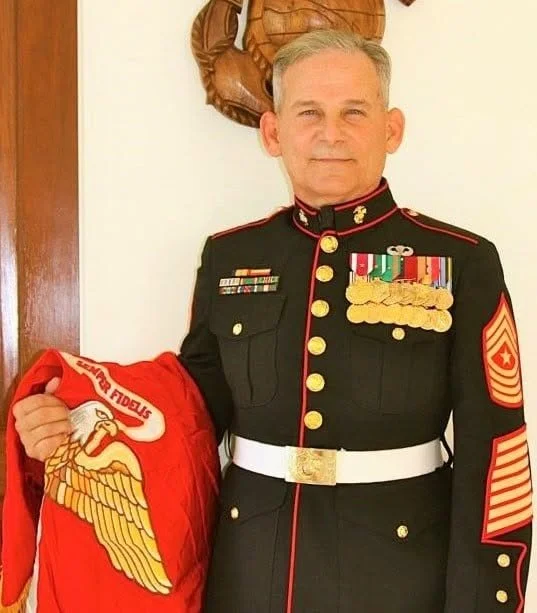
Retired Marine Sgt. Maj. Hubert “Bert” Caloud
“I’ve thought about him every day since he was killed,” Jennings said when he learned the man was buried in Manila, “wondering where he was. Now I know. At least he had an honorable burial in a military cemetery. That’s a relief to know.”
Caloud has served with integrity since he entered the Marine Corps in October 1973. He retired in January 2004 and began working with the American Battle Monuments Commission in October 2003 while on terminal leave.
He has provided treasured information for others wanting to know about the service of veterans or their family members. He found much information for me about my cousin who landed on Omaha Beach in the early morning of June 6, 1944.
Now the superintendent of the Ardennes American Cemetery in Belgium, Caloud previously presided over Belgium’s Flanders Field Cemetery and the Aisne-Marne and Oise-Aisne-American cemeteries in France.
Before those years, he served around the world with specific duties and rank. Near the end of his career, he served in the wars in Afghanistan and Iraq as sergeant major of the 15th Marine Expeditionary Unit. His unit was training in Australia on 9/11 and a short time later was watching Tomahawks launched into Afghanistan from a Navy gun line off Pakistan.
From the USS Peleliu, the sergeant major’s unit flew into Pakistan to man search-and-rescue (SAR) sites during the bombing phase in case an aircraft went down. In early December 2001, Caloud said a Special Forces team headed toward Kandahar with a new controller, and he entered their coordinates, not “the bad guy’s,” and a B52 dropped a 15,000 “Daisy Cutter” bomb on them.
“It blew the American and Afghan freedom fighters all over the hill,” Caloud said. “Two American Marines and a sergeant first class were killed from the bomb. Another Marine made it to the triage tent where he later died. We put the body in a C-130 for his last ride that night.”
In November 2003, the unit was inserted in Afghanistan. Eventually, they went into South Afghanistan and worked their way up to Kandahar with other Marines, Special Ops forces, Deltas, SEALS, Aussie Special Air Service members, and elements of the 26th Marine Expeditionary Unit. More than 100 Taliban were killed in a night ambush on Route 1.
He said they watched B-52 strikes “light up the sky,” and kept John Walker Lindh, the “turncoat Taliban,” in a shipping container. Not long after that, Caloud became Gen. James Mattis’ sergeant major of Task Force 58. After burying some freedom fighters, he became known by the general as “The Cemetery Man.”
The Humvees also had problems operating on the Afghanistan ground. They were light and had traction problems. To help that, sand bags were added. Then they’d have problems moving, trying to travel in sands dunes.
“During this time,” Caloud said, “a ‘Code H’ was needed for one of the Humvees that was not operating well in the sand dunes. It was buried in a huge pit.
“We were in a pretty desolate area on the way to an ambush site, trying to find a way, and had to cross a stream,” he added. “We parlayed with the village elders, trying to find a fording site, and they said they would mark it. They did with young kids standing in the water like aiming stakes. I remember going by one whose lips were blue.
“On the other side, the Marines asked them what they would like. They pointed at our boot laces and ‘writing sticks.’”
This was real backwoods, he said. A few days later, a CH-46 Sea Knight transport helicopter was sent back to the area with some No. 2 pencils and a bunch of boot laces.
Then there was the Iraq War, often referred to as the Second Persian Gulf War. During a firefight in an urban area, the sergeant major went down to Fox Company, where a platoon sergeant explained to him that they were taking fire from a building and when it stopped, an Iraqi would walk out of a door and across to another building, where firing would start again.
They were basically feeling out the rules of engagement the Marines crossed the border with.
Caloud asked an NBC (nuclear, biological and chemical) officer to get the Barrett .50-caliber sniper rifle and told him next time that guy in civilian clothes crossed to another house, “put a couple .50-caliber rounds into the door.” He wasn’t there when that happened, but the shooting stopped.
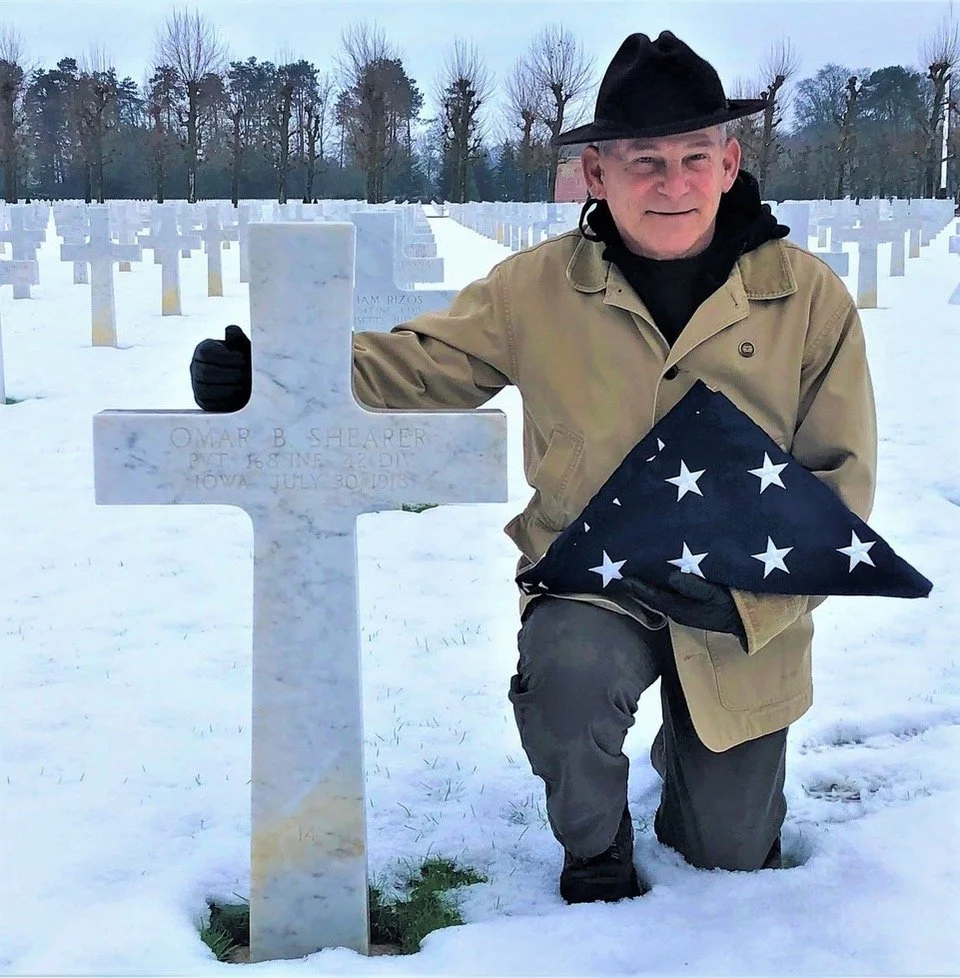
After his years of service in the Marine Corps, Caloud works to help veterans and family members find out more information about deceased service members interred in military cemeteries.
It was the same berm where Caloud said he and his men watched CNN film an F-14 dropping a 500-pound bomb on nearby buildings.
“It missed the right building,” he said, “but there was a spectacular explosion and dust signature, so the narration left out that part and aired it.”
In Nasiriyah, Caloud spent several days with Echo Company and the company gunny while they and several other units made diversionary attacks for the special forces to get Army Pfc. Jessica Lynch out of Sadaam Hospital.
“Lynch’s convoy was ambushed by Iraqi forces on March 23, 2003, resulting in her being seriously injured and captured,” he recalled. “She was held as a prisoner of war for nine days until a joint U.S. Special Operations team rescued her from an Iraqi hospital on April 1, 2003.
“Her rescue was highly publicized and made headlines as the first successful rescue of an American prisoner of war since World War II. We took the hospital grounds, then moved out the compound to a western bridge, and I moved over to Golf Company the next day.”
A day or two later, the Echo Company gunny and his command cell were pushing ammo up while clearing houses and one stepped on a mine. On a temporary duty assignment, Caloud went over to the field hospital to check on some other casualties and went looking for him. He had puncture wounds in his back from shrapnel and some cement debris that ricocheted off a masonry wall.
“It was a busy day in Iraq,” Caloud said. “Some patients were doing self-aid-buddy-aid.”
He found the gunny getting worked on by a paratrooper from the 82nd Airborne after being shot through the chin by an AK round. The gunny seemed ambulatory, so Caloud asked him if he was willing to go back to Echo.
He said yes, but since the hospital had taken his boots, the sergeant major took his off and gave the man his socks to wear, put his boots back on and got him back in the fight.
Caloud left the Marine Corps after “30 years, two months, and 29 days,” he said. “Best job I ever had.”
There’s much more to his life and service during those 30 years in the Marine Corps than is reported here. He’s had many assignments and is still working at a job he likes, believing in what he does and providing his service to this country as he has since he left the farm in Iowa in 1973.